💡 Key Takeaways
- Fire ants at a children's playground pose serious sting and allergy risks
- We used child-safe granular bait and targeted mound drenching — no broadcast spraying
- 12 active mounds were identified and treated across the playground perimeter
- Area was cleared for safe use within 48 hours of treatment
- Monthly monitoring programme prevents re-infestation in high-traffic areas
The Problem: Fire Ants Threatening Children's Safety
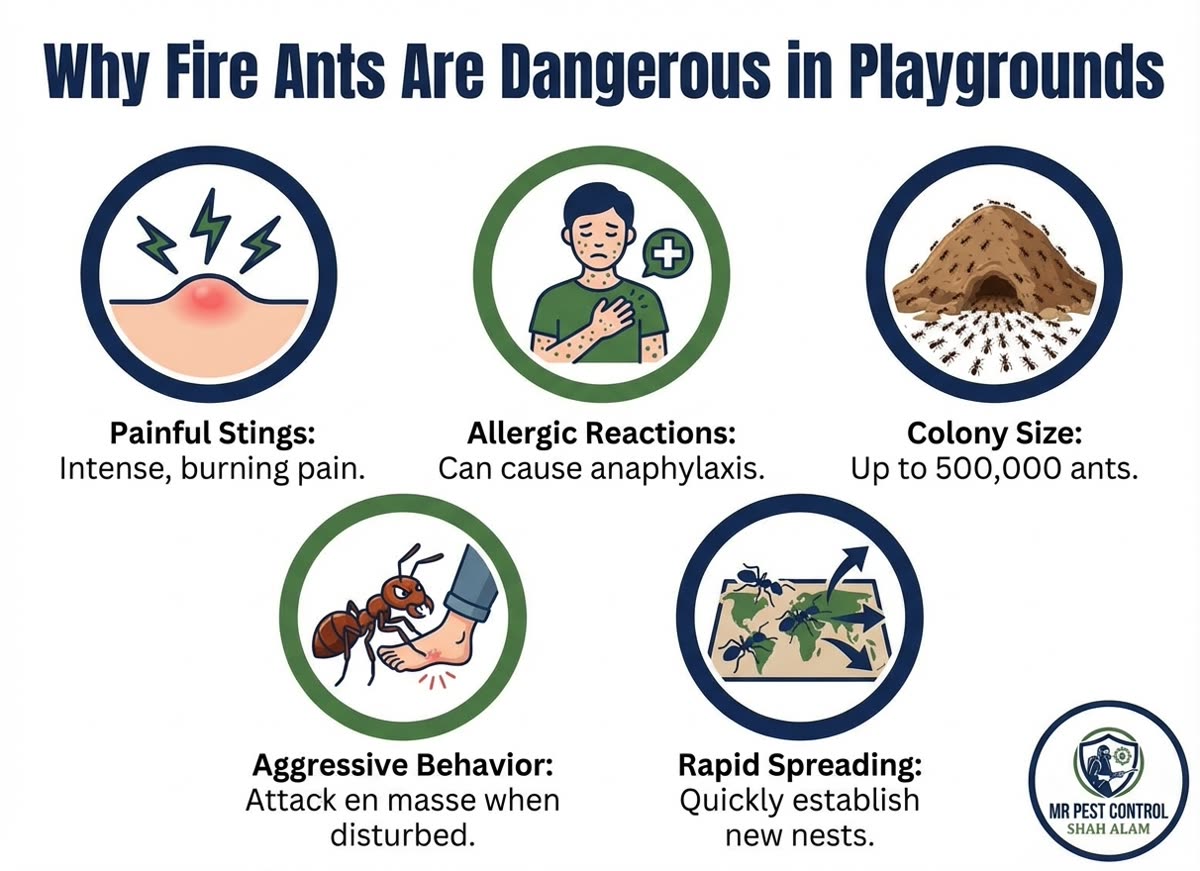
The management committee of a residential development in Eco Ardence contacted Mr Pest Control Shah Alam after multiple reports of children being stung by fire ants at the community playground. Several children had experienced painful welts, and one child had a mild allergic reaction requiring medical attention.
Fire ants (Solenopsis invicta) are among the most aggressive ant species found in Malaysia. Unlike common house ants, fire ants sting — and they do it in coordinated attacks. When a mound is disturbed, hundreds of ants swarm out and sting simultaneously. For young children playing on grass and sand, this is a serious safety hazard.
Site Assessment
Our team conducted a thorough inspection of the entire playground area, including the grassy perimeter, garden beds, and surrounding walkways. We identified 12 active fire ant mounds — some as large as 30cm in diameter — concentrated along the edge of the playground near ornamental shrubs.
The challenge was clear: we needed to eliminate the colonies completely while using only child-safe treatment methods. No broadcast chemical spraying could be used in an area where children play daily.
Treatment Approach
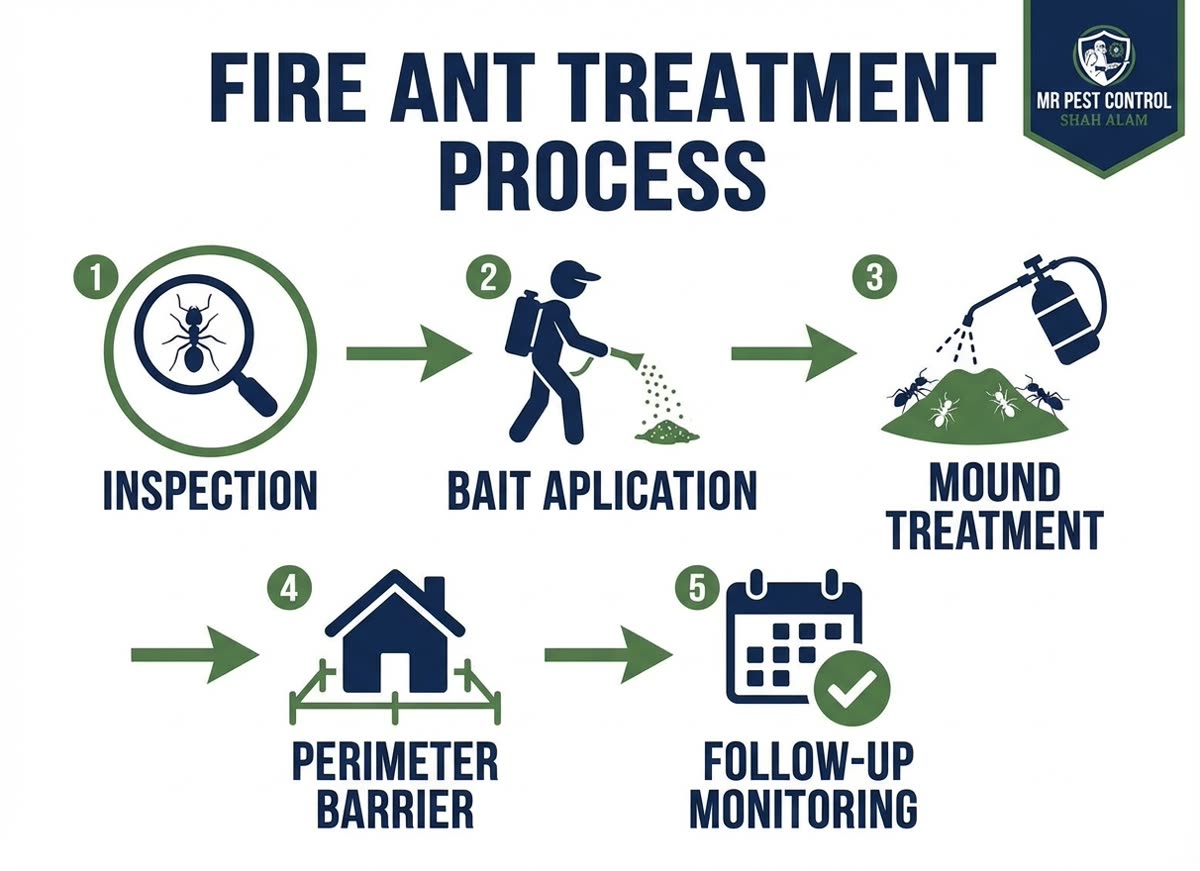
We designed a two-phase treatment plan specifically for this high-sensitivity environment:
Phase 1: Granular Bait Application
We applied professional-grade fire ant bait granules in a 1-metre radius around each identified mound. The bait contains a slow-acting insect growth regulator (IGR) that worker ants carry back to the colony and feed to the queen. This eliminates the colony from within over 7 to 14 days without exposing children to surface chemicals.
The granular bait was applied early in the morning when fire ants are most active in foraging. We used targeted application — only around identified mounds, not across the entire playground surface.
Phase 2: Mound Drenching
For the largest and most aggressive mounds closest to play equipment, we performed targeted mound drenching using a low-toxicity liquid treatment. This involves injecting the treatment directly into the mound to eliminate the colony immediately. The treated area was cordoned off for 24 hours to allow the product to dry completely.
Safety Measures
Given that this was a children's playground, we implemented strict safety protocols:
- All products used were classified as low-toxicity and approved for use near play areas
- Treatment was performed on a weekday morning when the playground was empty
- Warning signs were placed around treated mounds for 48 hours
- The management committee was briefed on re-entry safety timelines
- No broadcast spraying was used — all application was targeted to mound locations only
Results
Within 48 hours, all 12 mounds showed zero activity. A follow-up inspection at Day 7 confirmed complete colony elimination across the entire playground area. The playground was cleared for full use within 48 hours of treatment completion.
We enrolled the property on our monthly monitoring programme. Each month, our technician inspects the playground perimeter, garden beds, and surrounding areas for any new mound activity. If new colonies are detected, they are treated immediately under the 6-month warranty.
Why Professional Treatment Matters for Fire Ants
Many property managers attempt DIY fire ant control by pouring boiling water on mounds or using consumer-grade ant sprays. These methods rarely work because:
- Colony relocation: Disturbed colonies simply move to a new location nearby
- Queen survival: The queen is deep underground — surface treatments do not reach her
- Multiple queens: Some fire ant colonies have multiple queens, making elimination harder
- Rapid reproduction: A single queen can produce up to 1,500 eggs per day
Professional bait systems work because they exploit the colony's own food-sharing behaviour to deliver the active ingredient directly to the queen — the only way to permanently eliminate the colony.
📚 Sources & References
- Malaysian Agricultural Research and Development Institute (MARDI) — Fire Ant Management
- Department of Agriculture Malaysia — Invasive Species Control Guidelines
- University Putra Malaysia — Integrated Pest Management for Public Spaces
- Mr Pest Control Shah Alam — 8 Years of Field Experience (Est. 2018)
 Mr Pest Control Shah Alam