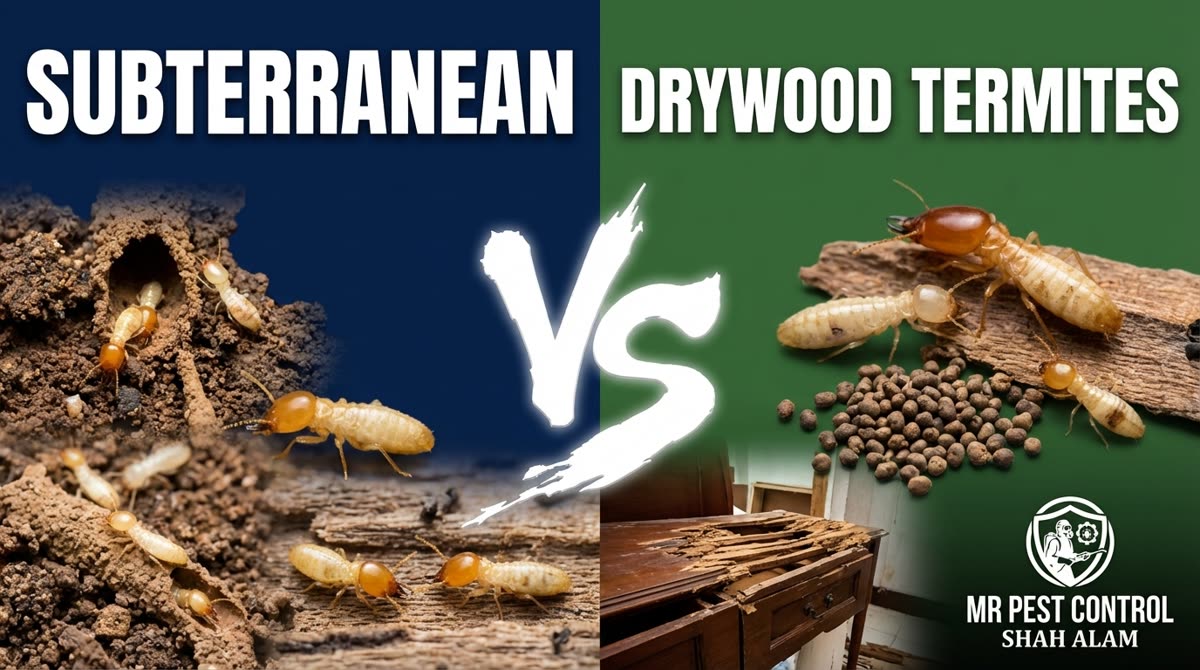
💡 Key Takeaways
- Subterranean termites build mud tubes and cause 90% of termite damage in Malaysia
- Drywood termites live inside wood with no soil contact — look for frass pellets
- Each species requires completely different treatment methods
- Shah Alam's tropical climate makes properties vulnerable to both species year-round
- Professional identification is critical — wrong treatment wastes money and time
Subterranean vs Drywood Termites
Malaysia is home to over 170 termite species, but two groups cause nearly all the property damage in Shah Alam: subterranean termites and drywood termites. Understanding which type you are dealing with is the first step to effective treatment — because the wrong approach can waste thousands of ringgit and leave the colony thriving.
At Mr Pest Control Shah Alam, we treat both species regularly across terrace houses, condos, and commercial properties. Here is everything you need to know to tell them apart.
Subterranean Termites: The Underground Invaders
How They Live
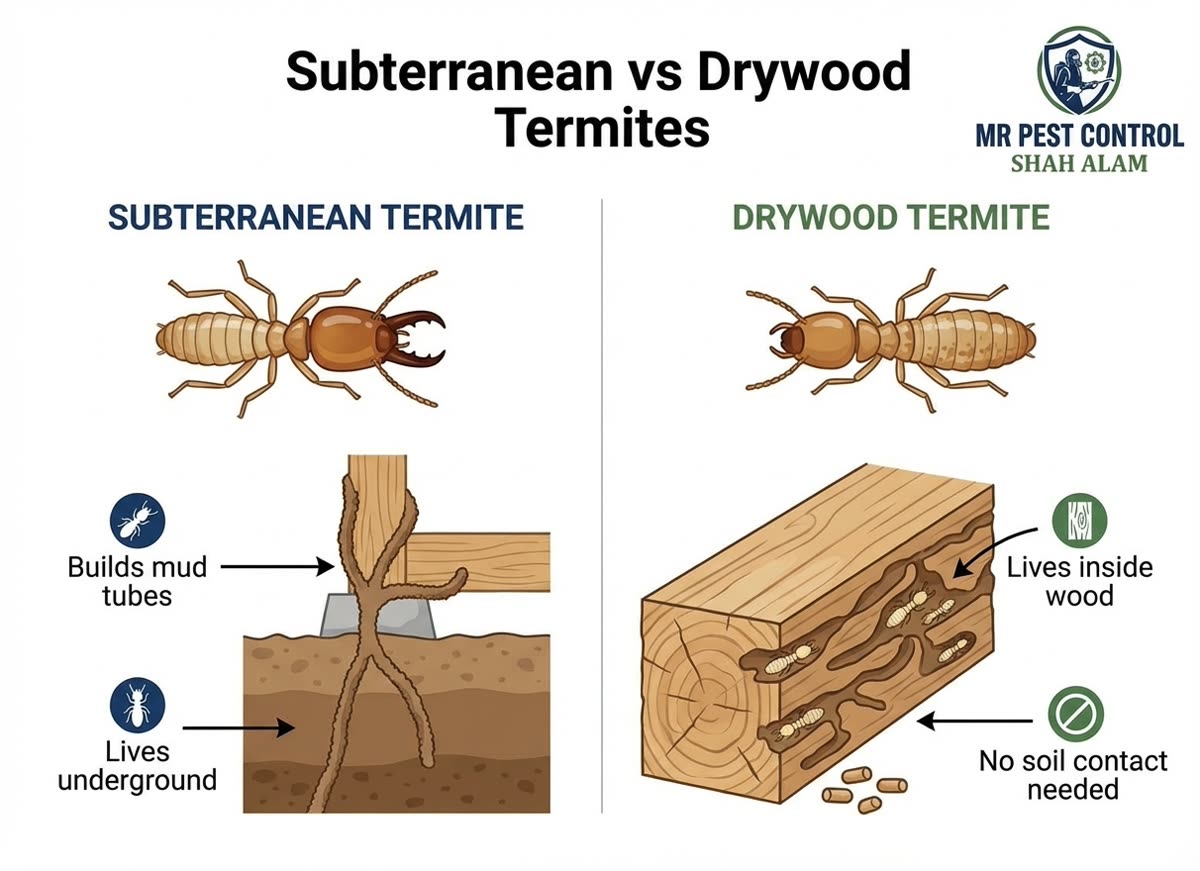
Subterranean termites build massive colonies underground — sometimes containing millions of individuals. They need constant moisture from the soil to survive. To reach the timber in your home, they construct mud tubes — pencil-thin tunnels made from soil, saliva, and faeces — along walls, foundations, and pipes.
These are the most destructive termites in Malaysia and across Southeast Asia. A single colony can consume up to 5kg of wood per day, and they work 24 hours a day, 7 days a week.
Signs of Subterranean Termites
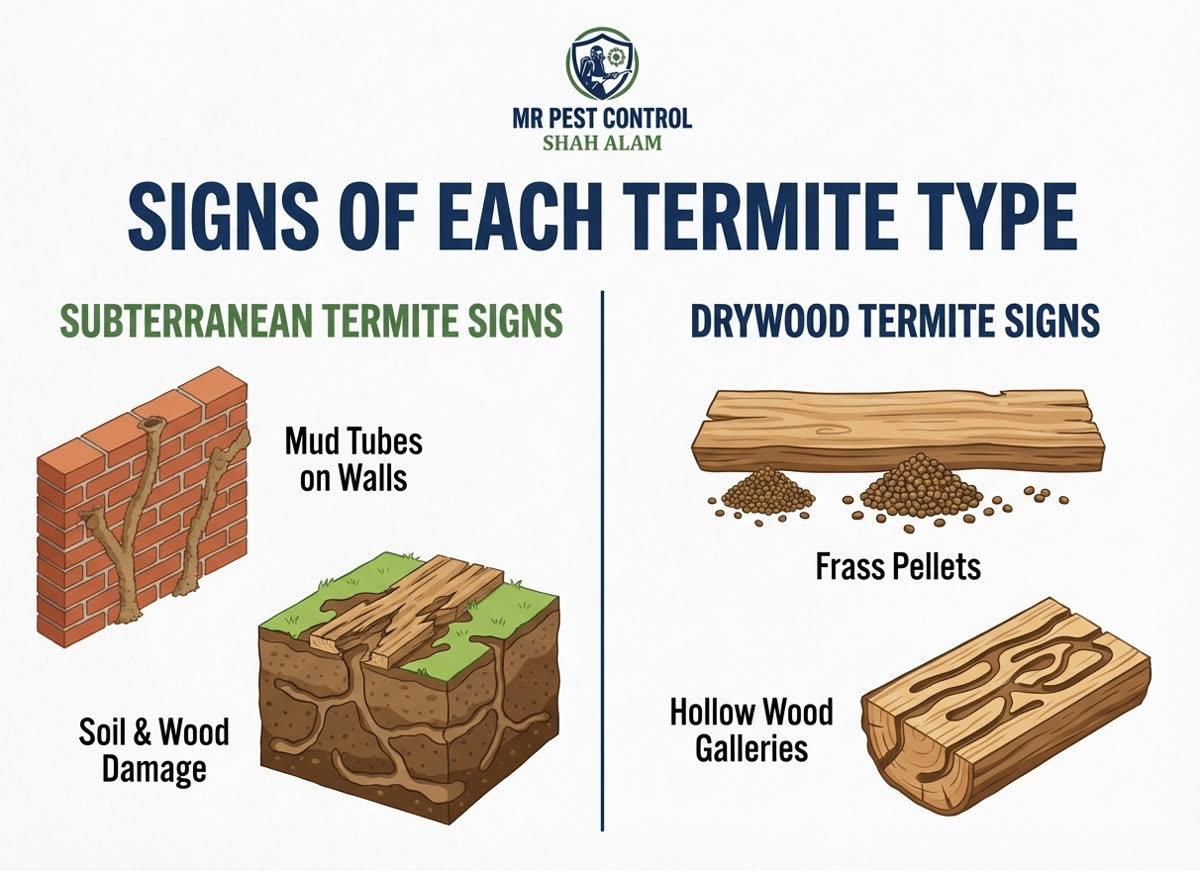
- Mud tubes on walls, foundations, and ceiling beams — the signature calling card
- Hollow-sounding timber when tapped — they eat from inside out
- Swarming alates (winged termites) after heavy rain, usually in the evening
- Warped doors and windows — moisture from termite activity causes timber to swell
- Bubbling paint on walls near timber structures
Where They Attack
Subterranean termites enter from ground level and work upwards. In Shah Alam terrace houses, they commonly attack door frames, skirting boards, built-in kitchen cabinets, and timber roof trusses. In areas like Kota Kemuning and Setia Alam, shared party walls between terrace units are a major vulnerability — one infested unit can spread termites to its neighbours through the shared wall structure.
Drywood Termites: The Silent Residents
How They Live
Drywood termites are fundamentally different. They do not need soil contact or external moisture — they extract all the water they need from the wood they eat. Small colonies of a few hundred to a few thousand individuals live entirely inside the timber, carving out chambers and galleries without ever touching the ground.
Because they do not build mud tubes, drywood termites are harder to detect. They can infest furniture, roof timbers, window frames, and hardwood flooring — even on upper floors of high-rise buildings.
Signs of Drywood Termites
- Frass (droppings) — tiny, oval-shaped pellets that look like fine sawdust, pushed out through small holes
- Small kick-out holes — pinpoint-sized openings in timber surfaces where frass is ejected
- Hollow timber — similar to subterranean damage but without mud tubes present
- Discarded wings — drywood swarmers also shed wings, usually found near windows
- No mud tubes — the absence of mud tubes with timber damage present points to drywood termites
Where They Attack
Drywood termites can infest any dry timber — antique furniture, wooden beams, picture frames, hardwood floors, and even wooden musical instruments. They are particularly problematic in older properties with untreated timber roof structures in areas like Seksyen 7 and Seksyen 13.
Head-to-Head Comparison
| Feature | Subterranean | Drywood |
|---|---|---|
| Colony size | Millions | Hundreds to thousands |
| Soil contact | Required | Not needed |
| Mud tubes | Yes — signature sign | No |
| Frass | No | Yes — pellet droppings |
| Moisture needs | High — needs soil moisture | Low — extracts from wood |
| Damage speed | Very fast — structural risk | Slower — localised damage |
| Common in Malaysia | ~90% of cases | ~10% of cases |
| Treatment | Baiting systems / soil treatment | Spot treatment / fumigation |
Treatment Differences: Why Identification Matters
Treating Subterranean Termites
Because subterranean termites have massive underground colonies, the goal is colony elimination — not just killing the termites you can see. The two main approaches are:
- Termite baiting systems — stations placed around the property containing slow-acting toxin that workers carry back to the colony, eliminating it from within. This is the gold standard for subterranean termites.
- Soil treatment (termiticide barrier) — a chemical barrier is applied to the soil around and beneath the building to block termite entry. Effective for pre-construction and post-construction treatment.
Treating Drywood Termites
Drywood termite treatment targets the specific infested timber:
- Spot treatment — injecting termiticide directly into the infested wood through drilled holes. Effective for localised infestations in accessible timber.
- Fumigation — sealing and gassing the entire structure or specific rooms. Reserved for severe or widespread drywood infestations.
- Heat treatment — raising the temperature of infested timber to lethal levels. Chemical-free option for furniture and smaller items.
Why the Wrong Treatment Fails
Applying a baiting system for drywood termites is a waste — they never leave the wood to encounter the bait. Similarly, spot-treating timber for subterranean termites only kills the workers present while the underground colony continues sending millions more. Correct identification saves money and delivers results.
Which One Do You Have?
Here is a quick checklist:
- See mud tubes on walls? → Subterranean termites
- Find tiny pellet droppings near timber? → Drywood termites
- Damage near ground level, working upward? → Likely subterranean
- Damage in roof timbers or upper-floor furniture? → Could be drywood
- Not sure? → Get a professional inspection. Both species can coexist in the same property.
If you are in Shah Alam and suspect termite activity, the team at Mr Pest Control provides free inspections with species identification, damage assessment, and a transparent treatment plan.
📚 Sources & References
- Malaysian Pest Management Association (MPMA) — Termite Species Guide
- Forest Research Institute Malaysia (FRIM) — Termite Biology & Ecology
- Department of Agriculture Malaysia — Termite Control Standards
- University of Malaya — Entomology Research on Coptotermes & Cryptotermes Species
- Mr Pest Control Shah Alam — 8 Years of Field Experience (Est. 2018)
 Mr Pest Control Shah Alam